
In many Indian homes, loud snoring is a family joke. “He snores like a tractor.” Everyone laughs — except, often, the person lying awake next to him, counting the silences between the snores. Those silences are no joke. They may be a sign of obstructive sleep apnea.
Suresh (name changed), 46, a business owner from Kukatpally, came in only because his wife insisted. She had recorded him on her phone at night: loud snoring, then complete silence for almost 30 seconds, then a sudden gasp and snort. He felt tired every day despite “sleeping eight hours”, his BP was hard to control on two tablets — and he admitted he had once nodded off at a traffic signal on the Outer Ring Road.
A sleep study showed his breathing stopped or became shallow over 40 times every hour. With CPAP therapy, he says he “woke up for the first time in ten years”. Within months, his BP readings improved too.
Suresh’s story is far from rare. An AIIMS-led analysis published in 2023 estimated that around 104 million Indian adults — roughly 1 in 10 — may have obstructive sleep apnea. Most of them don’t know it.
Key takeaways
- Not all snoring is sleep apnea — but loud snoring with pauses, gasping or daytime sleepiness needs checking.
- Sleep apnea is common in India (about 1 in 10 adults) and mostly undiagnosed.
- Untreated, it raises the risk of high BP, heart rhythm problems, stroke, diabetes and road accidents.
- Slim people can have it too — face and jaw structure play a big role, especially in South Asians.
- A sleep study confirms it, and treatments like CPAP are highly effective.
Simple snoring vs. sleep apnea
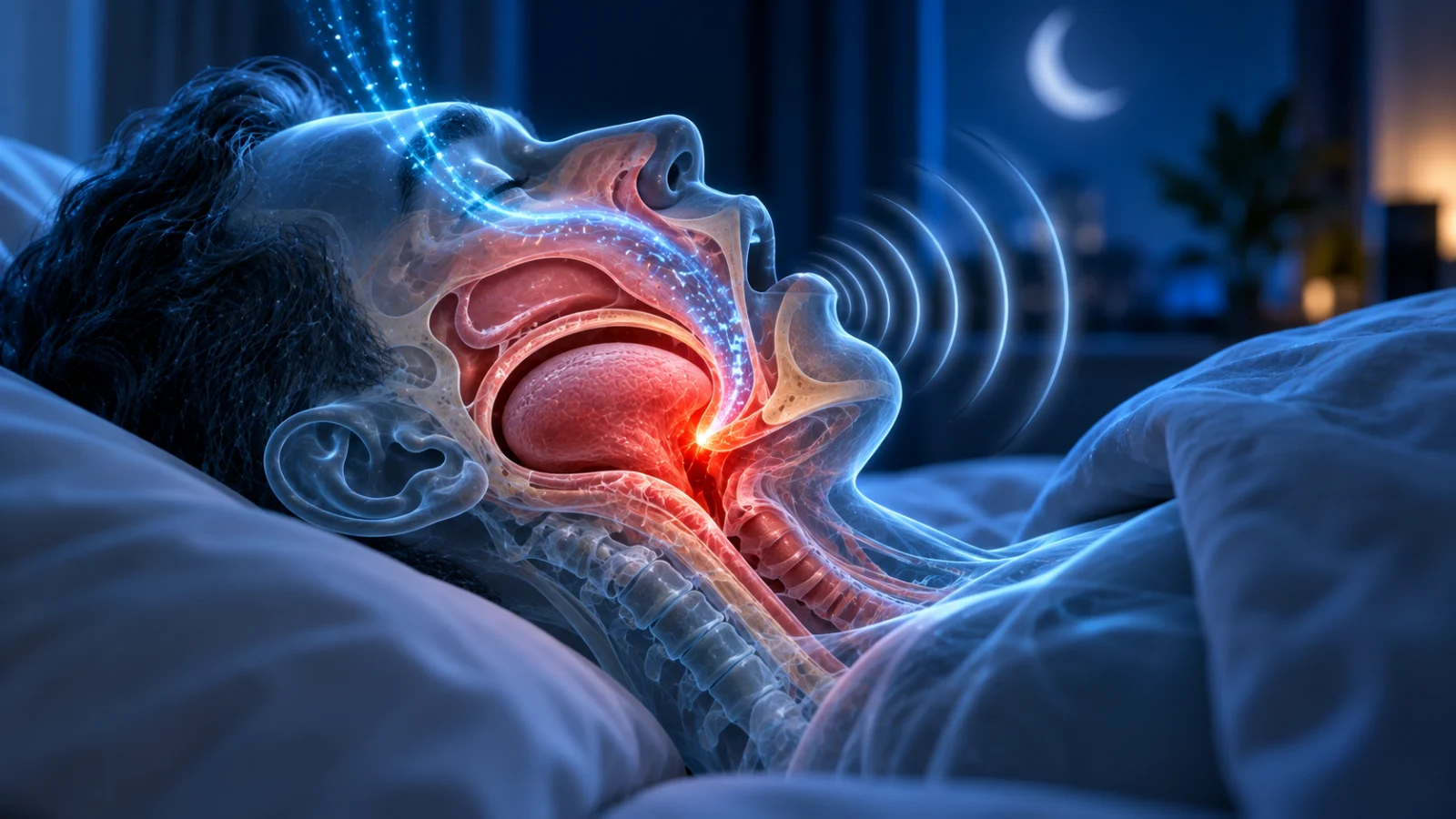
Snoring is the sound of air vibrating past relaxed tissues in the throat. Sleep apnea is when those tissues collapse enough to partly or completely block breathing. The two often go together, but they are not the same.
| Simple snoring | Obstructive sleep apnea | |
|---|---|---|
| Breathing | Continues normally | Repeatedly stops or becomes shallow |
| Sound | Steady snoring | Loud snoring broken by silences, then gasps or choking |
| Oxygen levels | Normal | Drop again and again through the night |
| Daytime | Usually feels rested | Tired, sleepy, foggy, irritable |
| Health impact | Mainly a nuisance for the bed partner | Linked to BP, heart disease, stroke, diabetes |
What happens in your body during an apnea
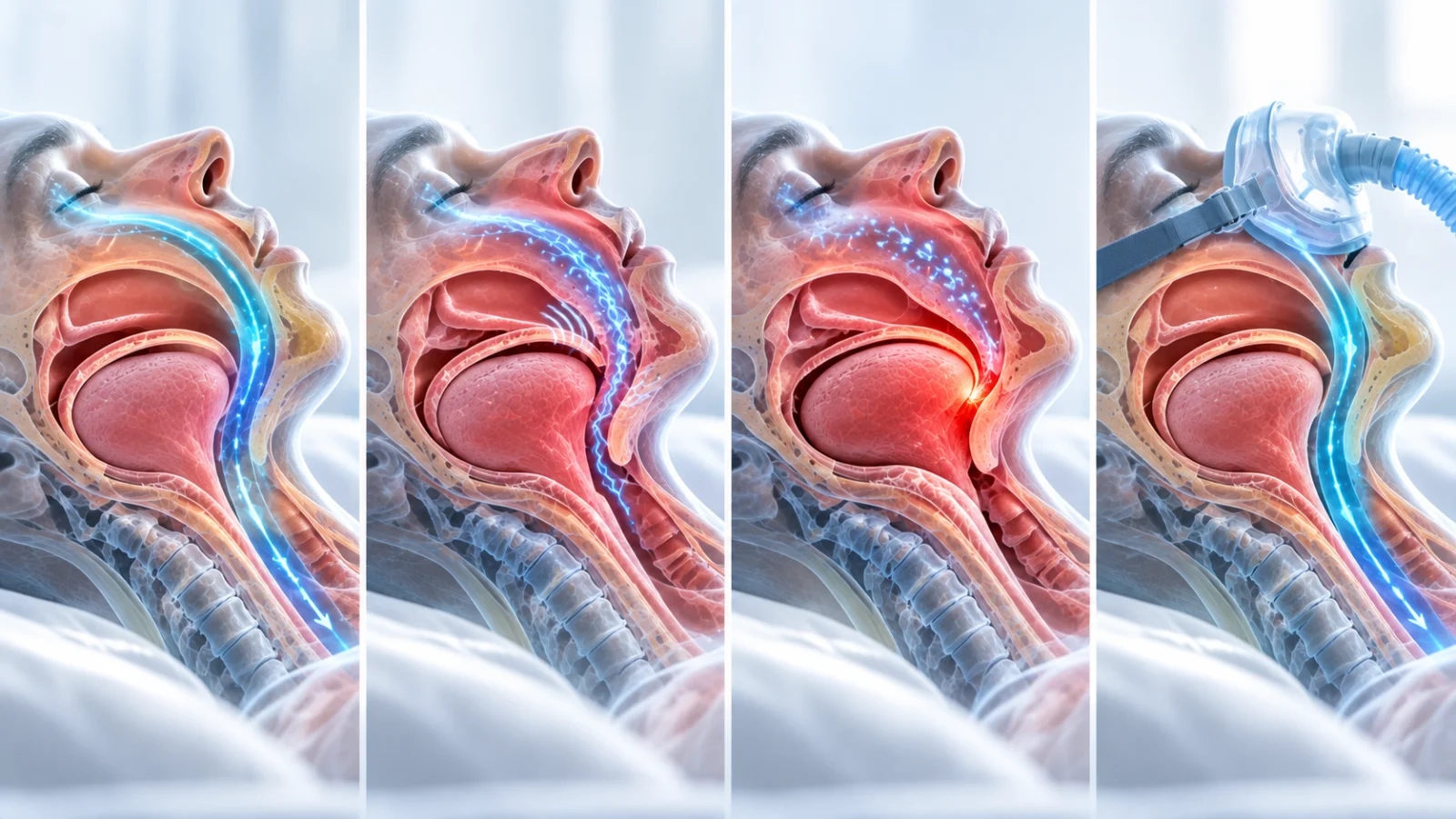
When you fall asleep, the muscles that hold your throat open relax. In sleep apnea, the tongue and soft palate fall back and seal the airway. You keep trying to breathe, but no air gets through. Oxygen levels fall, carbon dioxide rises, and your brain sounds an alarm. You partially wake — usually without remembering — with a snort or gasp, the airway opens, and the cycle starts again.
This can happen 5, 30 or even 60+ times an hour. Your body never gets the deep, restorative sleep it needs, and your heart and blood vessels take a repeated stress hit all night.
9 warning signs most people miss
Women and children are often missed. Women — especially after menopause — more often report insomnia, fatigue, headaches or low mood rather than loud snoring. In children, regular snoring, mouth breathing, bed-wetting, restless sleep and poor school performance or hyperactivity can point to sleep apnea, often due to enlarged tonsils and adenoids.
Quick self-check: the STOP-BANG questions
STOP-BANG is a simple, widely used screening tool. Give yourself one point for each “yes”:
- Snoring — Do you snore loudly?
- Tired — Do you often feel tired or sleepy during the day?
- Observed — Has anyone seen you stop breathing or choke during sleep?
- Pressure — Do you have, or are you treated for, high blood pressure?
- BMI — Is your BMI over 35? (Many Asian adaptations use a lower cut-off, as South Asians develop sleep apnea at lower weights.)
- Age — Are you over 50?
- Neck — Is your neck circumference over 40 cm (about 16 inches)?
- Gender — Are you male?
Your score: 0–2 suggests a low risk; 3–4 an intermediate risk; 5–8 a high risk. A score of 3 or more is a good reason to speak to a sleep specialist. This is a screening tool only — it cannot diagnose or rule out sleep apnea.
Why untreated sleep apnea is dangerous
Repeated oxygen drops and stress hormone surges every night affect almost every organ. Untreated moderate-to-severe sleep apnea is associated with:
- High blood pressure, including BP that resists medicines
- Atrial fibrillation and other heart rhythm problems, heart failure and heart attacks
- Stroke
- Type 2 diabetes and difficulty controlling blood sugar
- Road and workplace accidents due to drowsiness
- Fatty liver, depression, memory problems and reduced quality of life
- Higher risks during surgery and anaesthesia
The encouraging part: effective treatment improves sleepiness and quality of life, and can help with blood pressure control.
How sleep apnea is diagnosed
Sleep apnea is confirmed with a sleep study, which records your breathing, oxygen levels and other signals while you sleep:
- Polysomnography (lab sleep study) — an overnight study in a sleep lab that also records brain waves, heart rhythm and leg movements. It is the most complete test.
- Home sleep apnea test — a simpler device worn at home, suitable for many adults with a high likelihood of moderate-to-severe sleep apnea and no other major medical problems.
The key result is the Apnea-Hypopnea Index (AHI) — the number of breathing pauses or shallow breaths per hour:
Treatment options that work
CPAP — the gold standard
A CPAP (continuous positive airway pressure) machine gently blows air through a mask to keep your airway open as you sleep. Modern machines are small and quiet. Many people notice better sleep, sharper focus and more energy within days to weeks.
Weight loss
Even a 10% weight loss can noticeably reduce sleep apnea severity. Newer medicines are also being used: tirzepatide was approved by the US FDA in late 2024 for moderate-to-severe sleep apnea in adults with obesity. Ask your doctor whether options like this suit you.
Sleeping position and habits
Some people have apnea mainly when lying on their back; positional devices can help. Avoid alcohol and sleeping pills close to bedtime, as they relax the throat muscles further. Treating a blocked nose also helps.
Oral appliances and surgery
Custom-made dental devices that move the lower jaw forward help selected people with mild-to-moderate sleep apnea. Surgery (for example, removing large tonsils, or jaw procedures) is useful in specific situations, particularly in children with enlarged tonsils and adenoids.
Myths about snoring and sleep apnea
Get evaluated soon if
- Someone has seen you stop breathing or choke in your sleep
- You feel drowsy while driving, or have had a near-miss
- Your BP stays high despite medicines, or you have atrial fibrillation
- You are planning surgery and have loud snoring with daytime tiredness
Frequently asked questions
How do I know if my snoring is sleep apnea?
Can sleep apnea be cured permanently?
Is sleep apnea dangerous?
Can thin people have sleep apnea?
Which doctor treats sleep apnea?
Snoring, gasping or always tired?
Better sleep can change your energy, mood and long-term health. Dr. Subhakar Nadella evaluates and treats sleep apnea at KIMS Kondapur, Hyderabad — from sleep studies to personalised CPAP and lifestyle plans.
Learn more about our management of sleep disorders.

Dr. Subhakar Nadella
MD (Pulmonary Medicine) · Consultant Clinical & Interventional Pulmonologist, KIMS Hospital, Kondapur, Hyderabad
With over 10 years in pulmonary medicine — including more than 4 years in critical care and advanced interventions — Dr. Nadella treats the full spectrum of lung and breathing problems, from chronic cough, asthma and COPD to sleep apnea, interstitial lung disease, lung nodules and lung cancer.
- Flexible & rigid bronchoscopy
- Linear & radial EBUS
- Cryo lung biopsy
- Medical thoracoscopy
- Foreign body removal
- Sleep disorders
- Critical care
This article is for general education and does not replace a personal medical consultation. Please consult a qualified doctor for diagnosis and treatment. Patient names and details have been changed to protect privacy. Reference: Sharma SK et al. (AIIMS) meta-analysis on the prevalence of obstructive sleep apnea in India, Sleep Medicine Reviews, 2023; Chung F et al., STOP-Bang questionnaire.