
Most coughs are gone in a week or two. But some refuse to leave. You finish one bottle of cough syrup, then another. Sleep gets broken, colleagues start giving you looks in meetings, and someone at home says, “It’s just a throat infection.” If that sounds familiar, this article is for you.
Ravi (name changed), a 34-year-old software engineer from Gachibowli, caught a viral fever in August. The fever settled in four days. The cough didn’t. Six weeks later he was still coughing every night, had tried three different syrups and a course of antibiotics from a pharmacy, and was worried it was something serious.
His chest X-ray was normal. A simple breathing test told the real story: cough-variant asthma, triggered by the infection. With the right inhaler, his nights were quiet again within a few weeks. No more syrups needed.
Ravi’s case is common. A chronic cough is rarely “just a cough” — it’s a symptom with a cause. And once you find the cause, the cough is usually very treatable.

Key takeaways
- A cough lasting more than 8 weeks in adults is called a chronic cough; 3–8 weeks is “sub-acute”, often after an infection.
- In India, any cough lasting 2 weeks or more should be tested for tuberculosis — the test is quick and free at government centres.
- The most common culprits are post-nasal drip, cough-variant asthma and silent acid reflux — none of which a cough syrup fixes.
- Coughing up blood, weight loss, night sweats or breathlessness are warning signs that need prompt attention.
- A pulmonologist can usually pinpoint the cause with a few simple tests.
How long is “too long” for a cough?
Doctors classify cough by how long it has lasted, because the duration hints at the cause:
The India-specific rule: Because tuberculosis is still common here, India’s national TB programme advises that anyone with a cough for two weeks or longer should get a sputum test. Don’t wait for eight weeks if you have fever, weight loss or night sweats.
7 hidden causes of a cough that won’t go away
1Post-nasal drip (upper airway cough syndrome)
Mucus from an allergic or inflamed nose and sinuses trickles down the back of the throat and tickles the cough reflex. Clues: frequent throat clearing, a blocked or runny nose, a feeling of something “stuck” in the throat, and a cough that’s worse lying down. Treating the nose — not the chest — is what stops this cough.
2Cough-variant asthma
Not all asthma wheezes. In cough-variant asthma, a dry, irritating cough may be the only symptom. It is often worse at night or early morning, after exercise, in cold air, or around dust, perfume and smoke. It frequently starts after a viral infection — exactly like Ravi’s. A breathing test (spirometry) helps confirm it, and inhaled medicines work very well. If you’re worried about inhalers, read our article on whether asthma inhalers are addictive (they aren’t).
3Silent acid reflux (GERD)
You don’t need heartburn to have reflux. Acid and stomach contents rising up the food pipe can irritate the throat and trigger coughing — especially after heavy dinners, late-night meals, tea or coffee, or when lying down soon after eating. A hoarse voice in the morning is a common clue.
4Post-infectious cough
After a viral infection, the airway lining can stay sensitive for weeks. This cough usually fades by itself within eight weeks. Whooping cough (pertussis) can also cause a long, severe cough in adults, sometimes with bouts that end in vomiting or a “whoop”.
5Your blood pressure tablet
A class of BP and heart medicines called ACE inhibitors (names often ending in “-pril”, such as enalapril, ramipril or lisinopril) causes a dry, persistent cough in a noticeable minority of people. It can start weeks or even months after beginning the tablet. Never stop a medicine on your own — but do ask your doctor, because switching to another drug usually ends the cough.
6Tuberculosis and other infections
TB can begin quietly: a cough for two weeks or more, low-grade evening fever, loss of appetite, weight loss and night sweats. It is completely curable when diagnosed early and treated fully. Other infections, and conditions like bronchiectasis (damaged, widened airways, often after old TB), cause a long-standing cough with daily phlegm.
7Smoke, pollution and the lungs themselves
Cigarettes, beedis, hookah, mosquito coils, wood smoke and traffic pollution all irritate the airways. A long-term “smoker’s cough” may actually be early COPD. Less commonly, a chronic cough can come from interstitial lung disease (scarring of the lungs), a swallowed or inhaled foreign body, or a lung tumour — which is why a persistent cough in a smoker over 40 always deserves a check-up.
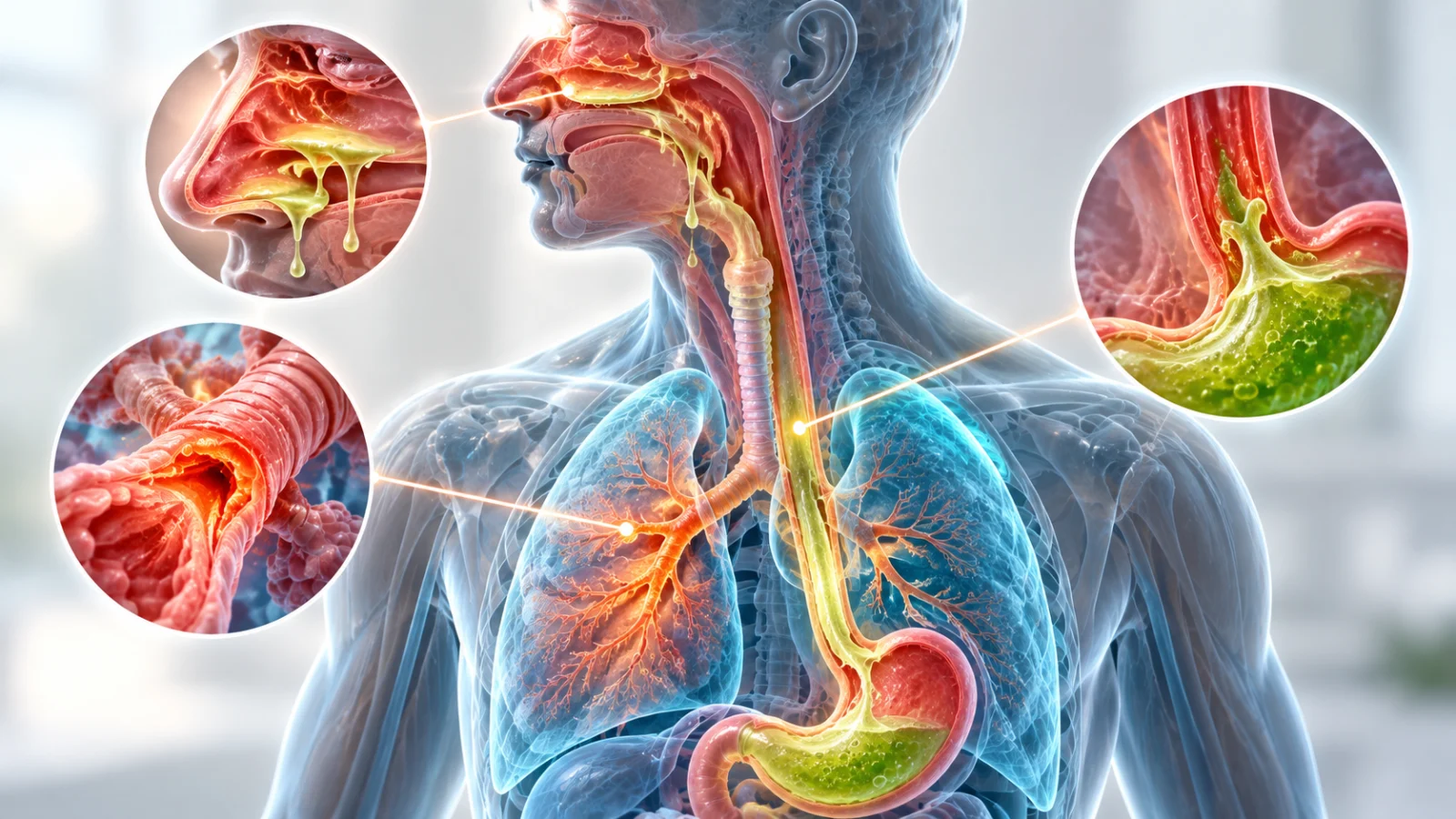
In real life, more than one cause is often at work — for example, post-nasal drip and reflux together. That’s one reason a cough can seem to “half improve” with one treatment and then linger.
Red flags: see a doctor promptly if you have
- Blood in your phlegm or coughing up blood (read about hemoptysis management)
- Unexplained weight loss, fever or drenching night sweats
- Breathlessness, chest pain or wheezing that is getting worse
- A hoarse voice lasting more than three weeks
- Difficulty swallowing, or choking episodes while eating
- A new or changed cough if you are a smoker or ex-smoker over 40
- A child with a sudden cough after playing with small objects or eating nuts
Common myths about chronic cough
What happens when you see a pulmonologist
Finding the cause is a step-by-step process, and most people don’t need every test. A typical evaluation includes:
- A detailed history — when the cough started, what triggers it, timing, medicines, smoking, pets, workplace dust and sleep pattern. This alone often points to the answer.
- Chest examination and oxygen check.
- Chest X-ray to look for infection, TB, scarring or masses.
- Spirometry (lung function test), often before and after an inhaler, to detect asthma or COPD.
- Sputum tests, including rapid molecular TB testing where needed.
- HRCT chest (a detailed CT scan) if the X-ray or symptoms suggest a deeper problem.
- Bronchoscopy in selected cases — a thin, flexible camera that looks inside the airways and takes samples. Learn more about flexible bronchoscopy.
Sometimes the doctor will start a “trial of treatment” — for example, a nasal spray or reflux medicine — and the response itself confirms the cause.
Safe relief while you get checked
- Honey (a teaspoon in warm water) can soothe a cough in adults and children over one year. Never give honey to babies under 12 months.
- Stay hydrated and sip warm fluids; steam inhalation can ease a blocked nose.
- Eat dinner at least 2–3 hours before bed and raise the head of the bed if you suspect reflux.
- Avoid smoke — including incense, mosquito coils and second-hand smoke — and wear a good mask on high-pollution days.
- Don’t self-medicate with leftover antibiotics, steroids or codeine syrups.
Frequently asked questions
When should I worry about a cough that won’t go away?
Can a cough last 2 months after a viral infection?
Why is my cough worse at night?
Which doctor should I see for a chronic cough?
Is a dry cough or a wet cough more serious?
Still coughing after three weeks?
Don’t keep guessing with syrups. Dr. Subhakar Nadella, Consultant Clinical & Interventional Pulmonologist at KIMS Kondapur, Hyderabad, can find the cause of your cough and help you breathe — and sleep — easy again.

Dr. Subhakar Nadella
MD (Pulmonary Medicine) · Consultant Clinical & Interventional Pulmonologist, KIMS Hospital, Kondapur, Hyderabad
With over 10 years in pulmonary medicine — including more than 4 years in critical care and advanced interventions — Dr. Nadella treats the full spectrum of lung and breathing problems, from chronic cough, asthma and COPD to sleep apnea, interstitial lung disease, lung nodules and lung cancer.
- Flexible & rigid bronchoscopy
- Linear & radial EBUS
- Cryo lung biopsy
- Medical thoracoscopy
- Foreign body removal
- Sleep disorders
- Critical care
This article is for general education and does not replace a personal medical consultation. Please consult a qualified doctor for diagnosis and treatment. Patient names and details have been changed to protect privacy.